

Prada solved Succession the hard way.
By appointing a CEO so powerful to be temporary.

Every institution that lasts long enough hits the same wall.
Not growth. Succession.
Eventually, the person in charge stops being obviously the right person in charge. Founders age. Families expand. Markets shift. Personal authority has to be converted into something sturdier: roles, rules, legitimacy that survives the original owner. When that conversion fails, the institution rarely collapses. It just drifts into meetings, factions, and vibes.
This is where most institutions actually break.
Luxury brands are especially exposed. Family control and heritage aren’t branding. They’re operating constraints. Someone really has the power. Someone really inherits it. And yet succession is often handled casually. The name is clear. The title is clear. The authority is assumed.
When this goes wrong, people call it nepotism. That misses the point. Nepotism is a moral story. This is a design problem.
The real question isn’t whether power stays in the family. It’s whether power is built to survive the family.
Is authority inherited by default, or deliberately engineered?
Prada is a clean case of this problem being handled deliberately, not rhetorically.
It’s family-controlled, creatively led, globally scaled, and culturally influential. Exactly the kind of institution where succession usually stays vague, political, or endlessly postponed.
Instead, Prada made succession explicit. Slow. Structural.
It treated authority as something to be engineered, not inherited.
The clearest signal was the CEO appointment.
Prada didn’t hand over the seat.
They built the system first and made inheritance wait for legitimacy.
The appointment of Andrea Guerra
In 2023, the board appointed Andrea Guerra as CEO of the Prada Group with full executive authority. Not as a transitional figure, but as a CEO empowered to run the system as if succession were not pending at all.
The mandate was explicit and structural: modernise operations, reinforce discipline, and preserve the seriousness of the role itself. Any future appointment of Lorenzo Bertelli, the founders’ son, to CEO was deliberately deferred until the institution - not the family - was ready to absorb it.
Succession, in this model, is not accelerated. It is enabled.
How authority is held together
This system only works if the CEO understands his role as stewardship, not reinvention.
Andrea Guerra is explicit about this. He does not talk about disruption. He does not perform transformation. His language is quieter and sharper: evolve, don’t change.
Protect what makes Prada and Miu Miu culturally distinct. Upgrade everything else.
That distinction matters. And Guerra, who had previously led family-controlled Luxottica through years of successful growth, knew exactly how to navigate that balance.
In luxury, “change” often becomes an excuse to flatten a brand into whatever the market currently rewards. Evolution requires judgment. It forces leadership to decide what is sacred and what is merely habitual.
Inside Prada, management is stripped of theory and inflated language. Guerra is openly anti-jargon. Execution beats frameworks. Clarity beats charisma. Doubt is treated as an asset, not a weakness.
This shows up operationally: short cadences, visible KPIs, accountability without constant panic. A high-bar, low-drama culture that assumes adults know how to operate.
Just as telling is what Guerra did not do.
He did not import an entourage. He did not surround himself with familiar lieutenants. Instead, he bet on the depth already inside the organisation.
That bet only works because Prada invested for years in capability rather than dependency.
The Prada Group Academy is not a brand story. It is infrastructure.
Craft is treated as strategic, not nostalgic. Knowledge is transferred deliberately, from master to apprentice, across leather goods, ready-to-wear, footwear, and industrial planning.
The same logic applies beyond the ateliers. Technology is treated as culture, not IT. ERP, CRM, forecasting, and industrial planning are internal muscles, built patiently by people who understand the brand.
Operations are not allowed to dilute creativity. They exist to protect it.
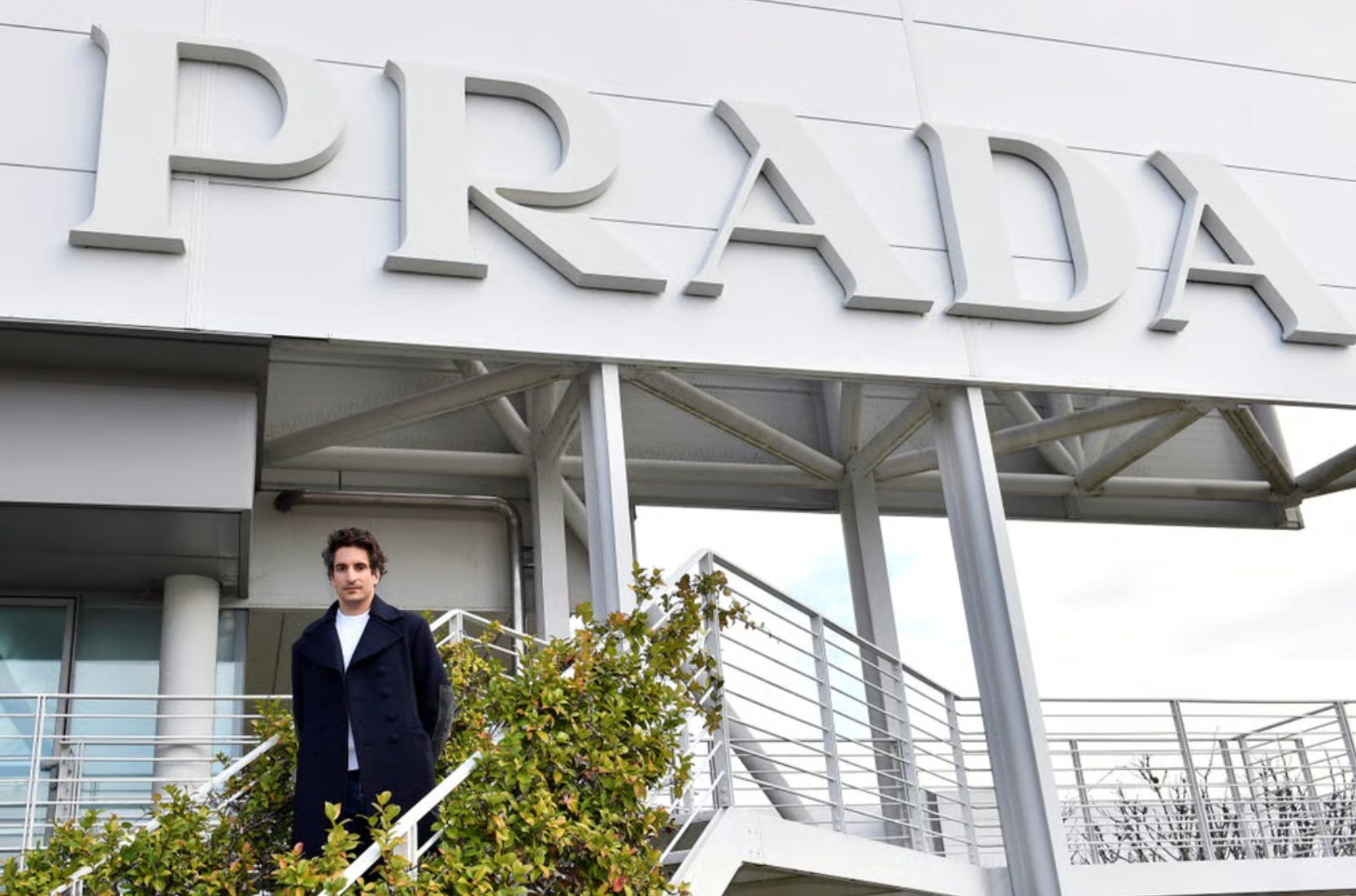
Lorenzo Bertelli, Photo: Reuters
Lorenzo Bertelli’s enablement
Most succession planning fails at the same point: enablement.
A name is chosen. A future is implied. The organisation is told to wait. And then nothing material changes around the chosen individual.
No expansion of authority. No exposure to real trade-offs. No operating context strong enough to reveal gaps early.
Prada flips this logic. Identification is treated as the starting point of the work, not the conclusion. Authority is not conferred symbolically. It is built through scope, friction, and accountability inside a functioning system.
This is the difference between planning succession and designing it.
Within this architecture, Lorenzo Bertelli’s role is deliberately bounded and deliberately serious.
His remit spans group-level marketing and corporate responsibility, placing him at the intersection of brand meaning, external legitimacy, and long-term trust. These are not peripheral functions. They are where modern institutional power is negotiated, constrained, and exercised.
Crucially, this authority exists under a fully empowered CEO. There is no ambiguity about who runs the system.
What matters here is not proximity to the top role, but exposure to consequence. Bertelli is operating inside the system, not above it.
That distinction preserves both credibility and learning.
Transparency, legitimacy, and why this works
Succession becomes destabilising when it is handled evasively.
Do we tell the successor?
Do we tell the team?
What happens to engagement?
Who leaves?
These questions are often treated as risks. In reality, they are diagnostics.
Opacity does not preserve trust. It postpones its loss.
When succession architecture is made explicit, the institution gains something more valuable than comfort: feedback.
People reveal whether they will back the system, not just the individual. Those who aspired to the role but were not chosen can see the standards, assess the gap, and decide whether to grow into it or exit. Both outcomes strengthen the institution.
Most disengagement does not come from losing. It comes from not understanding the rules of the game.
Prada’s approach works because it forces the decision framework into the open, where it must withstand scrutiny.
What other founder-led companies should learn
Every founder-led company eventually becomes a family business in disguise if it does not design how power is distributed, renewed, and constrained.
The lesson from Prada is not about fashion. It is about architecture.
Institutions survive when:
Ownership is acknowledged, not moralised
Authority is designed, not assumed
Succession is gradual, not theatrical
Standards are systemic, not personal
Talent matters. Brand matters. But neither survives badly designed power.
What founders should actually do next
If you are a founder thinking seriously about succession, the work is not conceptual. It is structural. Concretely:
Make the top role real.
Ensure the CEO role has full authority, clear accountability, and no parallel power structures. Succession cannot work if the role itself is compromised.Design development before naming successors.
Expand scope, responsibility, and consequence before any public signal. Naming without enablement simply delays failure.Be explicit about standards.
Define what readiness means in practical terms: decisions taken, trade-offs owned, failures absorbed. If you can’t explain the criteria, the organisation can’t trust them.Choose transparency over comfort.
Be clear about what is happening, who is involved, and why. Let the organisation test the decision early. People who disengage early would disengage later, at higher cost.Delay formal succession until credibility is visible.
Time is not the enemy. Unclear authority is. Let credibility build through performance, not proximity.
Succession isn’t about declaring the future. It’s about designing a system that can hold it.
Done right, it doesn’t just preserve the company, it matures it.
Disclaimer
This analysis is based entirely on publicly available sources: interviews, podcasts, articles, and content shared by Prada and Andrea Guerra. I haven’t worked with the company directly; this is my independent POV on what they’ve made public.
About
I’m Federica De Cillis, a leadership and organisational architect and founder of Arc Studio.
My work focuses on how decisions inside companies — about structure, incentives, control, and leadership — compound over time into outcomes.
I write Margin Call for founders, operators, and investors who are curious about how companies actually work beneath the surface: how optionality is created or lost, how judgment is tested under uncertainty, and why smart teams often end up where they do.